By the ThinkQuest Kids team · 6 min read
If you've ever felt guilty about how much time your child spends on a screen — you're not alone.
Screen time is one of the most loaded topics in parenting right now. Every few months a new study comes out. Headlines swing between "screens are destroying children's brains" and "technology is the future, embrace it." Parents are left somewhere in the middle, trying to make reasonable decisions with confusing information.
So let's cut through the noise.
Because the research on screen time and children's thinking is actually more nuanced — and more useful — than most headlines suggest. The question isn't really how much screen time your child is getting. It's what kind.
The Real Question Isn't "How Much" — It's "What Type"
Here's something researchers have found consistently: the effect of screen time on children's thinking depends almost entirely on what they're doing on the screen.
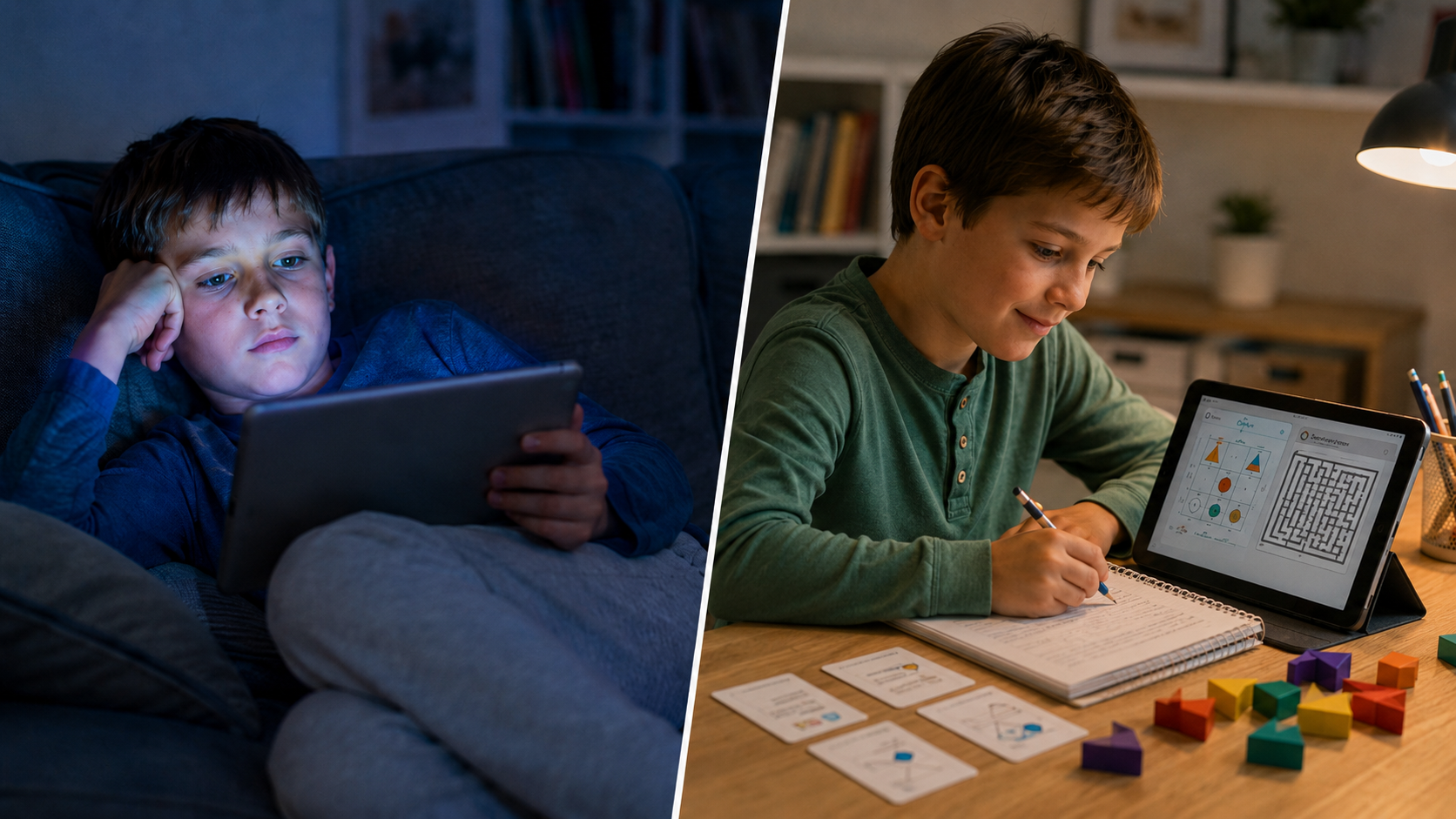
Two children can each spend an hour on a device. One watches videos passively, scrolling from one to the next without choosing, thinking, or engaging with anything. The other works through a puzzle, makes decisions, faces a challenge, gets something wrong, and tries again.
Same amount of screen time. Completely different cognitive experience.
The first child's brain is receiving information. The second child's brain is actively working. And those two things are not the same — not in the moment, and not in terms of what they build over time.
This is the distinction that matters. Not the clock. The activity.
What the Research Actually Shows
Let's look at what studies consistently find — without the alarm, and without the hype.
Passive screen time has real costs
Passive screen time means consuming content without making decisions, solving problems, or engaging actively. Think: watching videos, scrolling through short clips, or playing games that are essentially automated (press one button, watch things happen).
Research consistently links high levels of passive screen time in children aged 7–12 with:
Shorter attention spans — specifically, difficulty sustaining focus on tasks that require effort
Reduced ability to tolerate boredom — which sounds minor but matters enormously for learning
Less time spent on activities that build thinking skills — simply because there are only so many hours in a day
The key phrase there is "high levels." A child who watches an hour of videos a day and also reads, plays, builds things, and has conversations is in a very different position from a child for whom passive screens are the primary activity.
Active screen time tells a different story
Active screen time means the child is making decisions, solving problems, creating something, or engaging with content that responds to what they do.
Studies looking at this type of screen time find a much more positive picture:
Strategy games and puzzle games are consistently linked to stronger planning, pattern recognition, and flexible thinking
Creative tools — building games, coding platforms, digital art — build sequencing and problem-solving skills
Educational content that asks children to respond, choose, or apply what they've learned performs significantly better than passive video on thinking outcomes
The common thread: the child's brain has to do something. It has to make a choice, face a consequence, try again. That active engagement is what builds thinking — and it can happen on a screen just as well as off one.
What matters most of all
Here's the finding that gets the least attention: what surrounds screen time matters as much as the screen time itself.
Children who talk with a parent about what they're doing on a screen — even briefly — show better outcomes than children who use screens in isolation. Children who move between screen activities and physical activities, social play, and reading develop stronger thinking skills than those who stay in one mode for long stretches.
In other words: screen time doesn't exist in a vacuum. It's one part of a child's day. The question is what else is in that day — and whether the screen time your child is getting is the kind that exercises their thinking or replaces it.
How to Tell the Difference
Not sure whether what your child is doing on a screen is active or passive? Here's a simple way to think about it.
Ask yourself: is my child making decisions?
If yes — they're choosing between options, solving a problem, figuring out what to do next — that's active. Their brain is working.
If no — the content is just playing out in front of them, they're reacting but not deciding — that's passive. Their brain is receiving, not building.
A quick guide:
Type of screen activityActive or passive?Builds thinking?Watching YouTube videosPassiveRarelyShort-form video scrollingPassiveNoOpen-ended building gamesActiveYesStrategy and puzzle gamesActiveYesDrag-and-drop coding appsPartially activeSometimesStory-based problem missionsActiveYesAutoplay TV episodesPassiveRarelyCreative tools (drawing, building)ActiveYes
This isn't a perfect framework — context always matters. A documentary that sparks genuine curiosity and conversation is more valuable than this table suggests. A strategy game played mindlessly for four hours is less valuable than it implies. But as a starting point, the active/passive distinction is the most useful lens most parents don't have.
The "Intentional Screen Time" Idea
One concept worth knowing about is intentional screen time — the idea that what matters isn't just limiting screens, but being deliberate about what screen time is actually for.
Intentional screen time has a purpose. It exercises something. It asks the child to think, decide, create, or solve. It's chosen rather than defaulted to. And it has a natural end point — when the task is done, the episode is finished, the puzzle is solved — rather than the infinite scroll design of most passive platforms.
Unintentional screen time is what happens when a device is available and a child is bored. It defaults to the easiest, most stimulating option — which is almost always passive.
Neither of these is entirely avoidable. But being aware of the difference helps parents make better decisions — not by counting minutes, but by asking: "Is this screen time building something, or replacing something?"
Where ThinkQuest Kids Fits
ThinkQuest Kids is designed to be intentional screen time.
Each mission is a short, story-driven problem that requires a child to think, decide, and work through a challenge step by step. There's no autoplay. No infinite scroll. No passive consumption. The child is the one doing the thinking — the screen is just where the problem lives.
The missions are also short by design — most take 15 to 20 minutes. Long enough to practise something real. Short enough to be one part of a child's day, not the whole of it.
The goal was never to replace reading, playing, or building. It was to give children a structured, thinking-focused activity for the screen time that was going to happen anyway — and make it count.
The Bottom Line
The research on screen time doesn't say screens are bad. It says passive, unengaged, unintentional screen time has costs — and active, decision-making, problem-solving screen time can genuinely build thinking skills.
The practical takeaway for parents isn't "use screens less." It's "use screens better."
Notice whether your child is making decisions or just watching
Talk briefly about what they're doing, even once in a while
Choose some screen activities that require thinking alongside the ones that don't
Keep screens as one part of a varied day rather than the default
None of that requires perfect parenting or perfect schedules. It just requires a slightly different question: not "how long has my child been on a screen today?" but "what has their brain been doing while they were on it?"
Want to Know What Thinking Skills Your Child Is Building?
Our free 2-minute quiz gives you a personalised snapshot of where your child's thinking skills are right now — and a free mini pack of story missions to try at home.
Take the Free Quiz → https://thinkquestkids.com/
Free · 2 minutes · No coding knowledge needed · Ages 7–12
ThinkQuest Kids helps children aged 7–12 build logic, patterns, sequencing, debugging, and problem-solving skills through short story missions they can complete at home — with simple guidance for parents.