By the ThinkQuest Kids team · 6 min read
If you've ever browsed the kids' education apps, you've probably noticed how many of them are about coding.
Drag-and-drop blocks. Cute characters. "Learn to code" badges everywhere. It can feel like coding has become the default answer to "how do I help my child build thinking skills" — almost automatically, without much explanation of why.
Here's a question worth asking: does your child actually need to learn to code? Or is there something else going on — something coding apps are sometimes good at teaching, and sometimes not?
Let's break it down.
What Coding Apps Are Actually Teaching
Most kids' coding apps work the same way. A character needs to get from one place to another, or complete a task. Your child drags blocks — "move forward," "turn left," "repeat 3 times" — into the right order, and the character follows the instructions.
This is genuinely useful for one specific thing: understanding that computers follow instructions exactly, in order, with no room for "common sense." If you tell the character to turn left but you meant right, it turns left. Every time. That's an important thing to understand about how computers work.
But here's the part that's easy to miss: many children quickly figure out the pattern of the app rather than the thinking behind it.
They learn that this type of level usually needs a "repeat" block. That this shape of obstacle usually needs two turns. They start recognising level types rather than reasoning through each one from scratch.
This isn't a criticism of the children — it's actually a very normal thing for brains to do. We're built to find patterns and shortcuts. But it does mean that "finishing all the levels" doesn't necessarily mean "developed strong thinking skills." It might just mean "got good at this specific app."
What Thinking Skills Actually Are
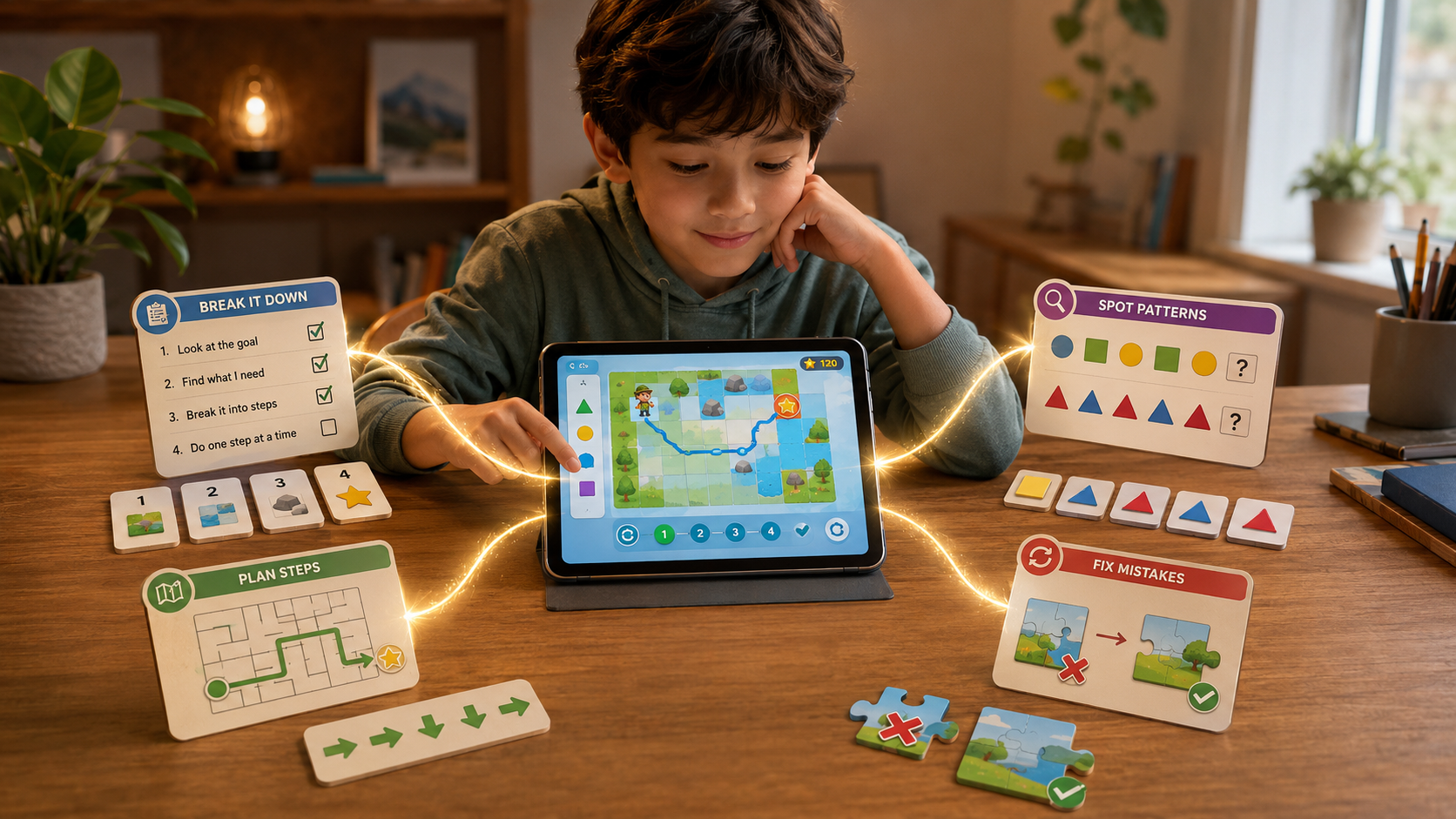
Thinking skills — sometimes called computational thinking — are the mental tools underneath coding, not the coding itself.
There are four of them, and none of them require a screen:
Breaking big problems into smaller pieces. Looking at something overwhelming and figuring out where to start.
Spotting patterns. Noticing that a new problem is similar to something you've seen before, even if it looks different.
Filtering what matters. Knowing which information in a problem is useful and which is just noise.
Making a plan that works every time. Building a step-by-step process you can rely on, and adjusting it when something doesn't go as expected.
These four skills are what coding actually uses. But they're also what cooking uses, what planning a trip uses, what figuring out a board game strategy uses, and what solving a maths problem you've never seen before uses.
Coding is one place these skills show up. It's not the only place — and for many children aged 7 to 12, it might not even be the best place to start.
So Which Does Your Child Need?
Here's a simple way to think about it.
If your child already enjoys coding apps and is engaged by them — great. They're getting some exposure to sequencing and following instructions precisely. Just be aware that finishing levels quickly might mean they've cracked the pattern of the app, not necessarily built deep thinking skills. It might be worth occasionally asking them to explain their solution out loud — that's where the real thinking gets tested.
If your child has tried a coding app and lost interest quickly — this is incredibly common, and it doesn't mean they're "not a coding person" or that thinking skills aren't for them. It might just mean the format didn't click. Dragging blocks to move a character through a maze is one way to practise sequencing. It's not the only way, and for a lot of children, it's not the most engaging one.
If your child finds coding apps confusing or frustrating — this is actually useful information. It might mean the foundational thinking skills — breaking things down, spotting patterns — aren't fully developed yet, and the coding layer on top is one step too many. Going back to basics, without the coding wrapper, can help these skills click into place first.
If you're not sure where to start — this is probably the most common situation, and it's completely fine. The honest answer is: most children benefit more from thinking skills practice that isn't wrapped in coding, at least to begin with. The coding can come later, once the underlying thinking is solid — and at that point, it tends to click much faster.
Why the Order Matters
Think of it like this: coding is a language for expressing instructions. Thinking skills are what you need in order to have good instructions to express.
If a child hasn't yet developed strong sequencing or pattern recognition, learning to code is a bit like learning to write essays in a language you're still learning to speak. You can technically do it. But it's harder than it needs to be, and the part you're actually trying to learn — clear thinking — gets buried under the part that's just hard because it's new and unfamiliar.
Build the thinking first. The coding — if your child wants it later — becomes much easier, because they already have something to say. They just need a new way to say it.
What This Looks Like in Practice
A child with strong thinking skills approaches an unfamiliar coding challenge by breaking it into parts, looking for patterns from problems they've solved before, and building a plan step by step — adjusting when something doesn't work.
A child without those skills yet, faced with the same challenge, often tries things somewhat randomly, gets frustrated when nothing seems to work, and either gives up or asks for the answer.
The difference isn't coding ability. It's the thinking underneath. And that thinking can be built through stories, puzzles, games, and everyday problem-solving — long before a single line of code is involved.
How ThinkQuest Kids Fits In
ThinkQuest Kids focuses entirely on the four thinking skills — decomposition, pattern recognition, filtering, and step-by-step planning — through short story missions. No drag-and-drop blocks. No coding syntax. Just problems that need solving, wrapped in an adventure.
The goal isn't to compete with coding apps or to say coding doesn't matter. It's to build the foundation that makes coding — and pretty much everything else — easier when your child is ready for it.
For children who later move on to coding, these missions provide exactly the kind of thinking that makes the transition smoother. For children who never become interested in coding at all, the thinking skills themselves are valuable on their own — in school, and in life.
Not Sure What Your Child Needs Right Now?
Our free 2-minute quiz looks at your child's age and how they currently approach problems — and recommends exactly where to start.
Take the Free Quiz → https://thinkquestkids.com/
Free · 2 minutes · No coding knowledge needed · Ages 7–12
ThinkQuest Kids helps children aged 7–12 build logic, patterns, sequencing, debugging, and problem-solving skills through short story missions they can complete at home — with simple guidance for parents.